Treatments for hair loss
Not all hair loss calls for a transplant. Alongside surgery, we perform PRP treatments in the clinic: a technique that supports weakened follicles with growth factors from your own blood. It works on the hair you still have, and it combines well with a procedure.
What we focus on
Haarkliniek Brugge is first and foremost a surgical practice. What we do ourselves, we do fully: hair transplantation, repair transplants and the PRP treatment that often goes with them.
PRP happens on site, by the doctor, in a limited number of sessions with a clear beginning and end. You come in, it happens, and we follow the result with photos.
What we deliberately don't do is supervise daily medication over the long term. That's dermatological work: it requires blood tests, years of monitoring and experience with side effects. A dermatologist is better placed for that than we are, and we'd rather say so than do it halfway.
What we carry out in the clinic
PRP treatment
Platelet-rich plasma from your own blood, injected into the scalp. The growth factors support follicles that are weakened but still alive. As a course on its own, or around a transplant to aid healing and graft survival.
Read moreMedication and investigation: via the dermatologist
Finasteride, minoxidil and the investigation of an underlying cause belong with a dermatologist. During the consultation we tell you whether that's the better first step in your case, and you leave with concrete advice.
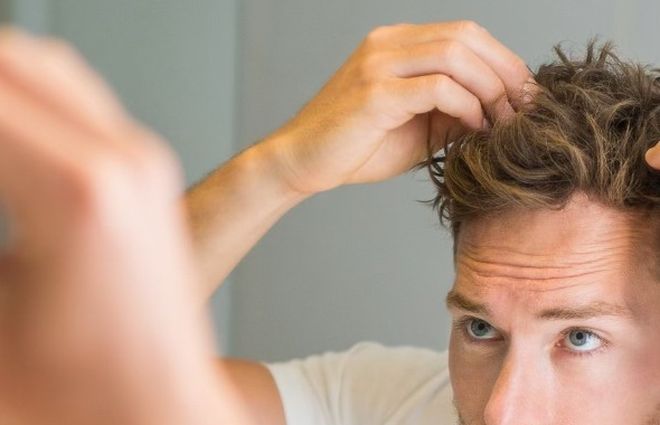
When medication is the better choice, we say so
For hereditary hair loss, medication is often the foundation. Finasteride and minoxidil are the best-evidenced options available: in a large majority they stop the loss, and in some they bring back growth. Those who start in time keep the most.
But that's a journey of years, with check-ups, adjustments and sometimes side effects. And if your hair loss has another cause, such as a thyroid problem, an iron deficiency or a scalp condition, such a drug does nothing while the real cause carries on.
For that we recommend an appointment with a dermatologist. They investigate the cause, prescribe where it makes sense and follow you up. If it then turns out that surgery or PRP is worthwhile, you come to us. And if you're already being treated, we take that into account when planning a procedure.
What you can realistically expect
PRP works, but slowly, and for as long as you maintain it. We always say this honestly:
- It works on what's still there. Weakened follicles can produce thicker hair again. Follicles that have gone don't come back.
- Allow three to six months. Before then you see little. That's why we photograph at every session.
- Maintenance is part of it. After a course of three, a session every six to twelve months. Stop entirely and you slide back.
- It's rarely the only treatment. The best results come from a combination, often alongside medication supervised by the dermatologist.
- With advanced loss it's support. Not a replacement for a transplant. We'll say so if it won't deliver enough.
Questions about hair loss
Do you prescribe finasteride or minoxidil?
No. Those drugs work, but they require years of dermatological follow-up and we're not set up for that. During the consultation we do discuss whether medication makes sense in your case, and we then recommend you make an appointment with a dermatologist.
If you're already being treated by a doctor or dermatologist, we of course take that into account when planning a procedure.
Can I stop hair loss without surgery?
With hereditary hair loss, often yes, if you start in time. Medication is the foundation and PRP the support. A transplant is for what's already gone; the rest is for what you still have.
Is PRP scientifically supported?
A growing number of studies show a positive effect on hair density and thickness in androgenetic alopecia, especially in combination with medication. It's not a miracle cure and results vary from person to person. We use PRP as support, not as the only treatment for advanced loss.
Can I come to you as a woman?
Absolutely. Hair loss follows a different course in women and a transplant isn't the right choice in every situation, but with a defined area and a stable donor area it works just as well as in men, and without shaving. Read more on the page about hair transplants for women.
Look first, then decide
Every journey starts with a consultation in which we map your scalp, your hair density and your stage. Only then do we talk about what makes sense. And if the answer is 'wait a little longer', we'll say so.
+32 50 68 10 60Mon – Fri during office hours