Hair transplant in Bruges
Surgical hair restoration with the FUE technique, performed by a physician, within a medical pathway. Whether a transplant is right for you follows from an examination of your scalp, your donor area and your stage. Sometimes the answer is: not yet.
What a FUE hair transplant actually is
In a FUE hair transplant (Follicular Unit Extraction) we remove follicles one by one from the donor area, the back and sides of the head where hair is genetically insensitive to balding. Those follicles, usually groups of one to four hairs, are placed back into the areas where hair has disappeared or thinned.
The difference from the older strip technique (FUT) is that no strip of skin is removed. So no linear scar remains. The tiny extraction points heal within a week and are not visible afterwards, even with short hair.
We work with a refined form of FUE in which the follicles are placed directly into the scalp with an implanter pen (DHI technique). That gives control over three things that determine the result: the angle, the direction and the depth of each hair. Get those three right and it goes unnoticed. Get them wrong and the result looks unnatural.
Why the hairline is the hardest part
Anyone can count grafts. What makes a transplant natural is the design: how high the hairline sits, how it curves at the temples, how irregular the first row is (a real hairline is never a straight line) and whether in ten years, with further hair loss, it still suits your face.
Dr De Wolf draws the hairline himself, during the consultation, and discusses with you why it sits where it sits. If you want a hairline that's too low or too straight, you'll hear why we won't do it. It's your head, but it's also the next twenty years.
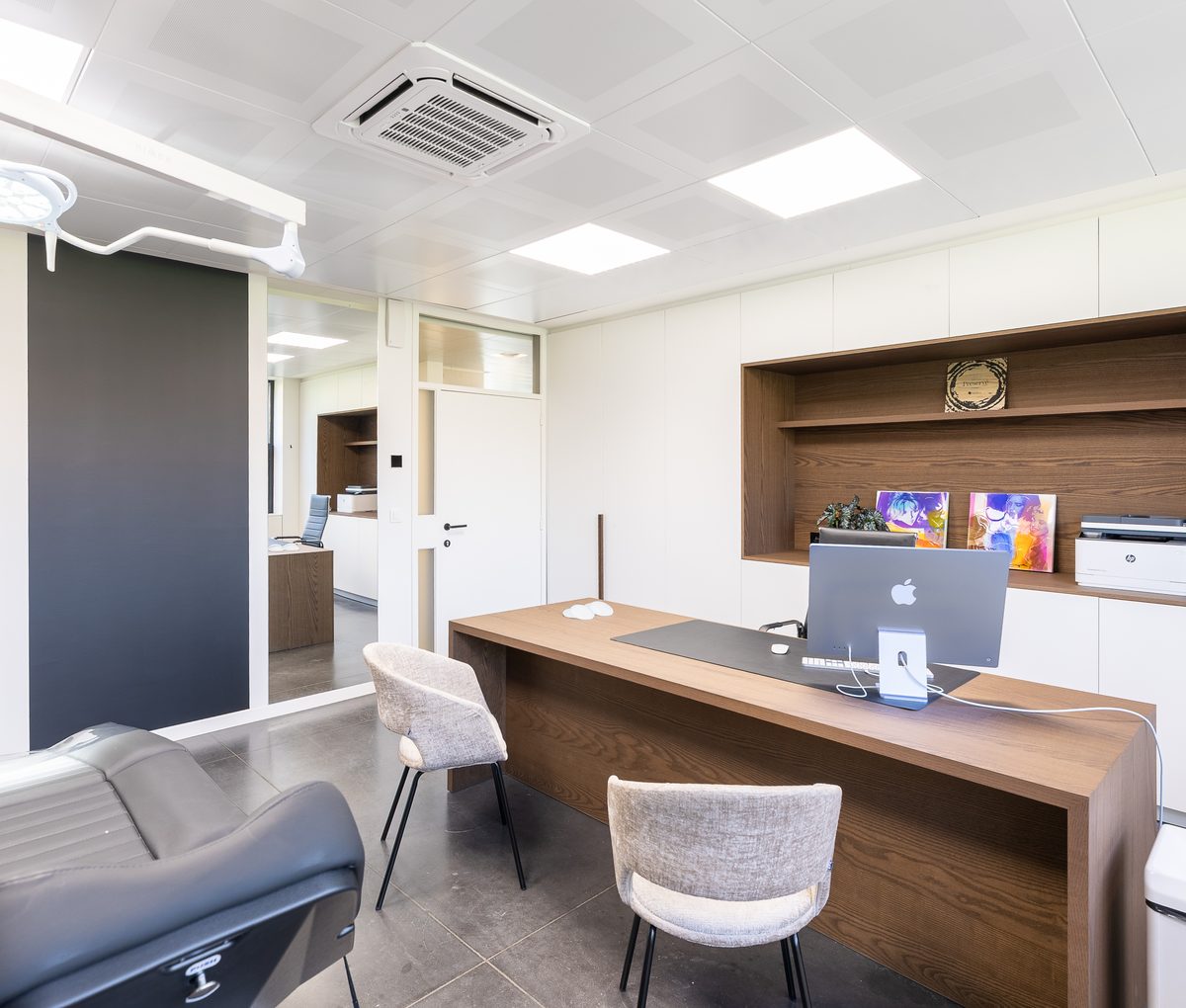
Where the procedure takes place
A hair transplant is surgery, and the room should be set up accordingly. We work in our own treatment room that meets the standards for minor surgery: surgical lighting, sterile instruments, an adjustable treatment chair and everything within the doctor's reach.
It isn't an operating theatre with a crew around it, and it doesn't need to be. What matters is that you stay in the same place all day, with the same team, in a room where you can sit up, read and eat in between.
Three kinds of procedure
Hairline and front
Restoration of receding temples and a receded hairline. The most requested, and the most decisive for how your face looks. Usually 1,200 to 2,500 grafts.
Densification
Targeted increase of density in thinning areas, such as the crown or mid-scalp, with no visible transition to your own hair. Often combined with a treatment to protect the existing hair.
Repair transplant
Correction of an earlier procedure that didn't turn out well: unnatural hairline, wrong direction, scarring or too little density. Needs more planning, because the donor area has already been used.
More about repairHow the day of your procedure goes
You're the only patient that day. The whole team is there for you, and nobody watches the clock.
Morning: design and anaesthetic
We redraw the hairline, you approve it. Photos for your file, then the local anaesthetic of the donor area. The injections are the least pleasant moment of the day.
Late morning: extraction
The follicles are removed one by one and sorted by the number of hairs per unit. They're kept cool and moist, because time outside the body helps determine how many take.
Afternoon: implantation
After a lunch break the doctor places the grafts according to the design: the finest single hairs at the front, the thicker groups behind for density. Angle and direction are set per graft.
Evening: home
You get a dressing for the donor area, your aftercare kit, written instructions and the team's direct number. Have someone collect you; we advise against driving after a day under anaesthetic.
What to expect, and what not
We don't promise a 'full head'. We promise a result that suits you, looks natural and that we follow up together for twelve months.
These are the things we put on the table in every consultation:
- The result comes slowly. The transplanted hairs fall out first. New growth from month three, final result after twelve months.
- The donor area is finite. An average head yields 5,000 to 7,000 usable grafts over a lifetime. We use them where they achieve the most.
- Your own hair can keep thinning. A transplant doesn't stop the process. That's why we also discuss how you protect the rest of your hair.
- There are risks. Infection, temporary numbness, swelling, a small percentage of grafts that don't take. Rare, but not zero. We name them.
- Sometimes it's too early. Under 25 or with rapidly evolving loss, we'd rather wait and stabilise first.
- The price is fixed. What we agree in the treatment plan is what you pay. No supplements afterwards.
Frequently asked questions about hair transplants
Does a hair transplant hurt?
The procedure is done under local anaesthetic. The anaesthetic injections are briefly unpleasant; after that you mostly feel pressure, not pain. During the day itself you read, listen to music or doze. The evening and the first few days afterwards, the scalp is tender and a little tight. Ordinary painkillers are enough.
How long will I be out of action?
Office work is usually possible after three to five days, physical work after about ten days. During the first week the treated area is visible (small scabs and some redness). After ten to fourteen days that's gone. Light exercise after one week, intensive exercise after two to three weeks. The journey page has a day-by-day timeline.
When will I see results?
Later than most people think. The transplanted hairs largely fall out after two to six weeks (that's normal; the follicle stays in place). From the third or fourth month new growth starts. After six months you see a clear difference; the final result is judged after twelve months. That's why our follow-up runs that long.
Is the result permanent?
The hairs from the donor area at the back and sides of the head are genetically insensitive to the hormone that causes baldness. Once moved, they keep that property. What can continue to thin is your own hair around the transplant. That's why during the consultation we also look at how best to protect that hair: with a treatment in the clinic, or with medication supervised by a dermatologist.
Am I a good candidate?
That depends on three things: whether your hair loss is stable enough, whether your donor area has enough strong hair, and whether your expectations match what's achievable. We assess that during the consultation. Sometimes the answer is that it's still too early, or that your hair loss needs to stabilise for six months before we can plan. That's not a rejection; it's the right order.
Who performs the procedure?
Dr Maurits De Wolf, who holds degrees in both medicine and dentistry, designs the hairline and performs the critical steps of the procedure himself. He is assisted by a permanent nursing team that works exclusively with hair. You meet the same people at the consultation, on the day itself and at every check-up.
Do I need to stay overnight in Bruges?
No. Most patients simply go home. If you're travelling from far away or would rather recover in peace, you can stay overnight in a private suite in the same building, with the medical team close at hand. Entirely optional.
Look first, then decide
Every journey starts with a consultation in which we map your scalp, your hair density and your stage. Only then do we talk about what makes sense. And if the answer is 'wait a little longer', we'll say so.
+32 50 68 10 60Mon – Fri during office hours